Research group
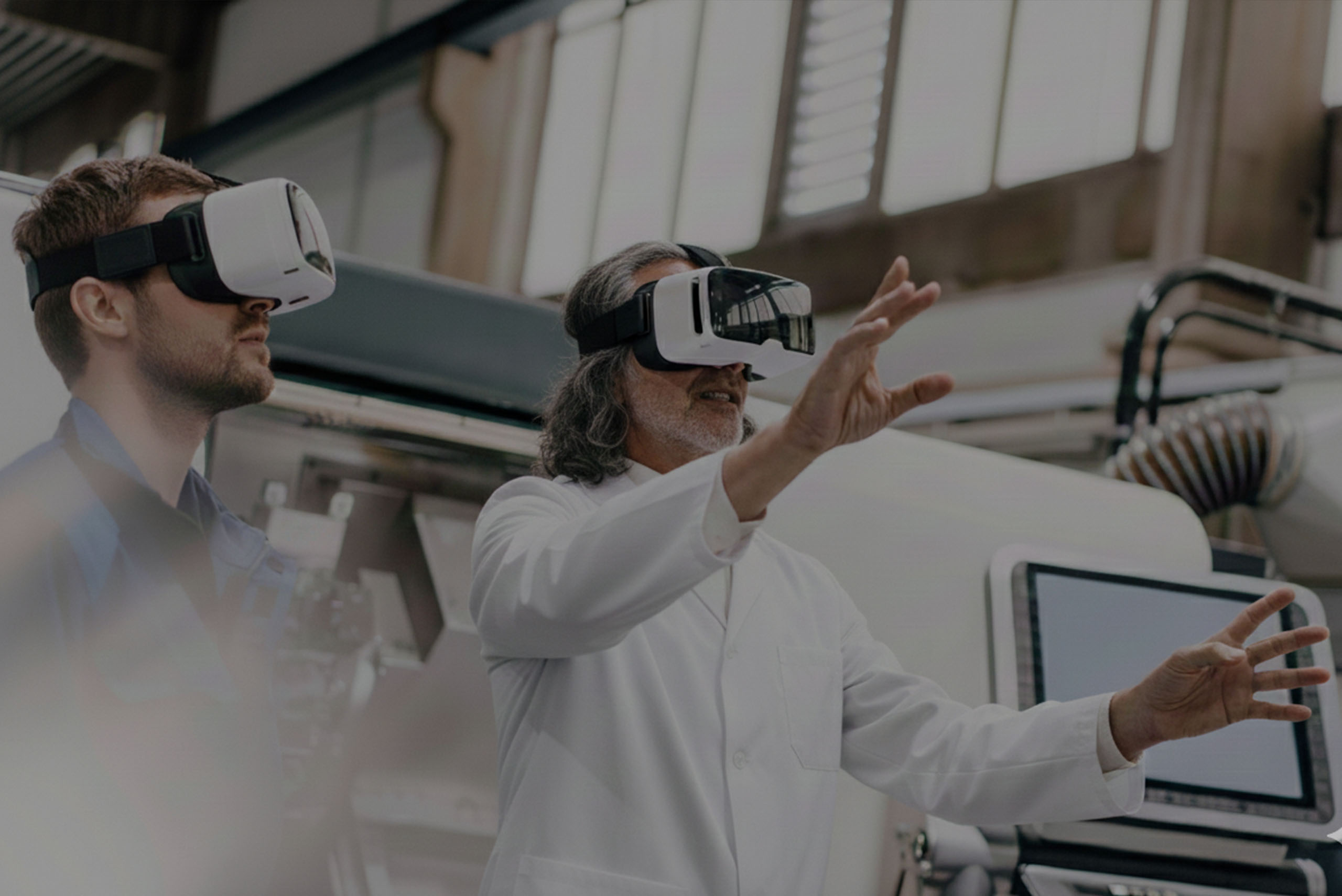
We research the interactions between cyber-physical systems and humans — the basis of hybrid intelligence, in which humans use the capabilities of technology and vice versa.
What is CPHS
Cyber-Physical & Human Systems (CPHS) consist of cyber-physical computer systems and humans. Cyber-Physical Systems arise from the networking of embedded systems through wired or wireless communication networks — with applications in medical systems, assistance systems, control, automation and logistics, security, and systems for monitoring the environment, communication, and culture, e.g. as a digital twin. CPHS additionally focus on the interactions between CPS and humans, which take place physically and digitally in cyberspace.
Four guiding questions
How can new technologies be used sensibly to further improve CPHS?
How can systems and people grow together in a meaningful human–machine symbiosis?
What new opportunities do CPHS open up in industry and health?
What role does artificial intelligence play in a CPHS, and how can it be used beneficially?
Section 01
The group combines two focal points — the cyber-physical system and the human system — connected in space and time, and increasingly on a cyber-digital level as a digital twin. Artificial intelligence is the link between the two, researched here on the basis of different applications, such as smart assistance and augmented reality.
FOCUS 01
 The technical capabilities of the systems: the increasing performance of embedded systems and advancing miniaturization of hardware, including sensors, enable new types of systems in prototype and product development. In mobile systems especially, wireless transmission technologies facilitate convenient use and user acceptance.
We research solutions for
FOCUS 02
 The augmentation of humans, expanding their capacities in cyber-physical space: assistive augmentation with mobile systems requires a seamless integration of technological systems with our body, the expansion of our cognitive, perceptual and motor skills, and the ability of a system to implicitly understand the human context — made possible by artificial intelligence, which links the digital twins.
We research solutions for
Section 02
The CPHS.group is jointly headed by the Professors Denys Matthies and Horst Hellbrück.
Professor · Group Head

Professor · Co-Head

Research Associate

Teaching Assistant

Research Associate

Research Associate

Research Associate

Research Associate
Section 03
2026
GlucoSole: 3d-printed plantar pressure sensing insole for combined resistive and capacitive sensing
The Cost of Convenience: How Delegation and Decision Horizons Erode Human Agency when overusing LLM Systems
Aligning With the Dead: Posthumous Persistence as a Limit Case for Bidirectional Human-AI Alignment
The Future Smart Shoe: Demonstrating Sensing-to-Actuation Prototypes
2025
Hacking Rokoko Smart Gloves for Tool Detection using Recurrent Neural Networks
Toward Low-Complexity Arrhythmia Classification for Ambient Assisted Living
No Cloud, No Problem: A Real-Time HAR Insole with On-Device Inference
Walking the Future: Bridging Foot Augmentation into Next Steps of Human Augmentation
Technical Analysis for Electro-Sensory 3D Foot Scanning in a Shoe
How AI Is Shaping Society and Why We Must Keep It at Bay!
Minimal Hepatic Encephalopathy in Cirrhotic Patients: A New Simple and Fast Digital Screening Method
PhantomFolds: Exploring Unobtrusive Spatial Tactile Feedback Produced by Two Fingernail Mounted LRAs for In-Air and On-Surface Mixed Reality Applications
2024
SurfSole: Demonstrating Real-Time Surface Identification via Capacitive Sensing with Neural Networks
ShoeTect2.0: Real-time Activity Recognition using MobileNet CNN with Multisensory Smart Footwear
FlyAI - The Next Level of Artificial Intelligence is Unpredictable! Injecting Responses of a Living Fly into Decision Making
SonicVista: Towards Creating Awareness of Distant Scenes through Sonification
The Cyber-Placebo: Intelligent CPHS with Fake-AI?
Kavy: Fostering Language Speaking Skills and Self-Confidence Through Conversational AI
Bridge Detection in Autonomous Shipping: A YOLOv8 Approach with Autodistill and GroundedSAM
SALOS—A UWB Single-Anchor Indoor Localization System Based on a Statistical Multipath Propagation Model
Evaluation of the Modular Design Structure for the UWB Single Anchor Localization System SALOS
Real-Time BLE Angle-of-Arrival Localization with Gauss-Newton
On Weight Functions for Multipath-Assisted Radio Tomographic Imaging Algorithms
Comparative Study of Narrowband and Ultra- Wideband Systems for Device-Free Localization
Inland Waterway Vessel Autonomy: Sensor and Communication Design
2023
User Generated Inverted Item Evaluation (UGIIE)
NOSEwrist: Natural Olfactory Substitution and Extension wrist
Cyber-Physical & Human Systems (CPHS)–A Review and Outlook
PneuShoe: A Pneumatic Smart Shoe for Activity Recognition, Terrain Identification, and Weight Estimation
Throughput Maximization Using Deep Complex Networks for Industrial Internet of Things
Two Industrial Reference Demonstrators for High Throughput and Low Latency in 5G Standalone Network Setups
MA-RTI: Design and Evaluation of a Real-World Multipath-Assisted Device-Free Localization System
LoomoRescue: An Affordable Rescue Robot for Evacuation Situations
2022
Wearable Sensing of Facial Expressions and Head Gestures
ShoeTect: Detecting Body Posture, Ambulation Activity, Gait Abnormalities, and Terrain with Multisensory Smart Footwear
TickleFoot: Design, Development and Evaluation of a Novel Foot-tickling Mechanism that Can Evoke Laughter
Practical Security Analysis and Measures for 5G Private Industrial Standalone (SA) Deployments
Evaluation and Error Correction of Position Tracking Systems of Autonomous Vehicles for Indoor Localization
Effect of Object Diameter Specific Reflections to Underwater Ultrasonic Multipath Diffraction Measurements
Feature Identifier for Underwater Ultrasonic Multipath Diffraction Model
Underwater Ultrasonic Multipath Diffraction Model for Short Range Communication and Sensing Applications with Reflector
Evaluation of 3-dimensional Electrical Impedance Tomography-Arrays for Underwater Object Detection
Spectral Ultrasonic Underwater Buried Object Detection and Localization
Evaluation of an Electrical Impedance Tomography Model for Underwater Object Detection
Evaluation of 3-dimensional Electrical Impedance Tomography-Arrays for Underwater Object Detection
A Reference Deployment of a Minimal Open-Source Private Industry and Campus 5G Standalone (SA) System
Multisensor Platform for Underwater Object Detection and Localization Applications
Spectral Ultrasonic Underwater Buried Object Detection and Localization
Exploiting Ultra-Wideband Channel Impulse Responses for Device-Free Localization
HLS: Hierarchical Lossless Segmentation - A New Approach for Bilevel Image Compression
SALOS - a UWB Single Anchor Localization System based on CIR-vectors - Design and Evaluation
Latency and Energy Consumption of Convolutional Neural Network Models from IoT Edge Perspective
2021
ClothTiles: A Prototyping Platform to Fabricate Customized Actuators on Clothing using 3D Printing and Shape-Memory Alloys
Prototyping Smart Eyewear with Capacitive Sensing for Facial and Head Gesture Detection
mobiLLD: Exploring the Detection of Leg Length Discrepancy and Altering Gait with Mobile Smart Insoles
DIY-PressMat: A Smart Sensor Mat for Posture Detection Applicable for Bed-exit Intention Detection, Pressure Ulcer Prevention, and Sleep Apnea Mitigation
CapGlasses: Untethered Capacitive Sensing with Smart Glasses
EyeKnowYou: A DIY Toolkit to Support Monitoring Cognitive Load and ActualScreen Time using a Head-Mounted Webcam
GymSoles++: Combining Google Glass with Smart Insoles to Improve Body Posture when Performing Squats
Flexible Data Acquisition with LoRaWAN and MQTT for Small and Medium-sized Enterprises
Flexible Arbitrary Signal Generation and Acquisition System for Compact Underwater Measurement Systems and Data Fusion
High Precision Open Laboratory 3D Positioning System for Automated Underwater Measurements
Underwater Ultrasonic Multipath Diffraction Model for Short Range Communication and Sensing Applications
Object Localization in Seawater via Electrical Impedance Measurements
Inference and Performance Analysis of Convolutional Neural Networks used for Human Gesture Recognition on IoT-Devices
Gigahertz Ground Penetrating Radar (GPR) for Sediment Exploration
Modeling the Interference of Ultra-Wideband Signals in Multipath Propagation Channels
Modeling the Path Losses of Ultra-Wideband Signals in Multipath Propagation Channels
Modeling UWB Multipath Propagation considering Material-Dependent Reflection Effects
FitFone: Tracking Home Workout in Pandemic Times
Location Awareness in the Internet of Things
Measurement of Blood Pressure by Ultrasound - The Applicability of Devices, Algorithms and a View in Local Hemodynamics
Brachialis Pulse Wave Measurements with Ultra-Wide Band and Continuous Wave Radar, Photoplethysmography and Ultrasonic Doppler Sensors
Sind portable intelligente Geräte für die Diagnostik in der Hausarztpraxis geeignet?
Interoperabilität, technische Schnittstellen…? Ein Beitrag zum Verständnis von Praxisinformationssystemen
Comparison of I/Q- and Magnitude-based UWB Channel Impulse Responses for Device-free Localization
Detection and Identification of Multipath Interference with Adaption of Transmission Band for UWB Transceiver Systems
2020
Touch me gently: recreating the perception of touch using a shape-memory alloy matrix
StressFoot: Uncovering the Potential of the Foot for Acute Stress Sensing in Sitting Posture
AiSee: An Assistive Wearable Device to Support Visually Impaired Grocery Shoppers
Differential Ultrasonic Detection of Small Objects for Underwater Applications
MAMPI-UWB—Multipath-Assisted Device-Free Localization with Magnitude and Phase Information with UWB Transceivers
MAMPI – Multipath-assisted Device-free Localization with Magnitude and Phase Information
Contact-Free Biosignal Acquisition via Capacitive and Ultrasonic Sensors
Verfahren zur kontaktlosen Messung wenigstens eines Vitalparameters eines Patienten
Collaboration
We are more than happy to welcome any students that are interested in research. THL-students can browse the Thesisboard to get more details for open projects.